Is SaaS Dead? What to Replace, What to Keep, What It Costs
No, SaaS is not dead. But paying per seat, every month, for tools a small team could run on one server it owns is getting harder to justify, and mature self-hosted apps can now replace several of them.
The honest version has three lists: what to replace, what to keep, and what owning it costs you in money, time and risk. This page is all three, with dated prices and the House of Loops material each one comes from.
List prices were read from each vendor's pricing page on 25 September 2026, in US dollars. Server prices come from the House of Loops scale guide, checked on 23 September 2026. Self-hosted alternatives are the ones the House of Loops courses teach, on the versions they pin. Prices change: check them on the day you decide.
Where did "SaaS is dead" come from?
From the stock market. In early February 2026, software company shares fell hard on fears about what AI would do to companies that sell software by the seat. Bloomberg's headline on 4 February was "What's Behind the 'SaaSpocalypse' Plunge in Software Stocks". CNBC's on 6 February was "AI fears pummel software stocks: Is it 'illogical' panic or a SaaS apocalypse?"
Search followed. US Google searches for "saaspocalypse" went from 10 in January 2026 to 9,900 in February. "saas is dead" peaked at 2,900 in May (DataForSEO data in House of Loops keyword research, September 2026).
Subscription fatigue is older than the sell-off. US searches for "subscription fatigue" ran between 260 and 720 a month over the twelve months to August 2026, in the same research. A share price is not a business decision. The question for a five-person company is narrower: which of the tools you rent could you own, and is that worth the work?
What is self-hosting?
Self-hosting means running an application on a server you control, a VPS or a box in your office, instead of renting it as a service. The software is usually open source, or source-available like n8n. The data sits in your database. There is no per-seat bill.
In exchange, you are the operations team. Backups, upgrades, security patches and noticing when it breaks are yours.
What can a small team replace, and what does it cost now?
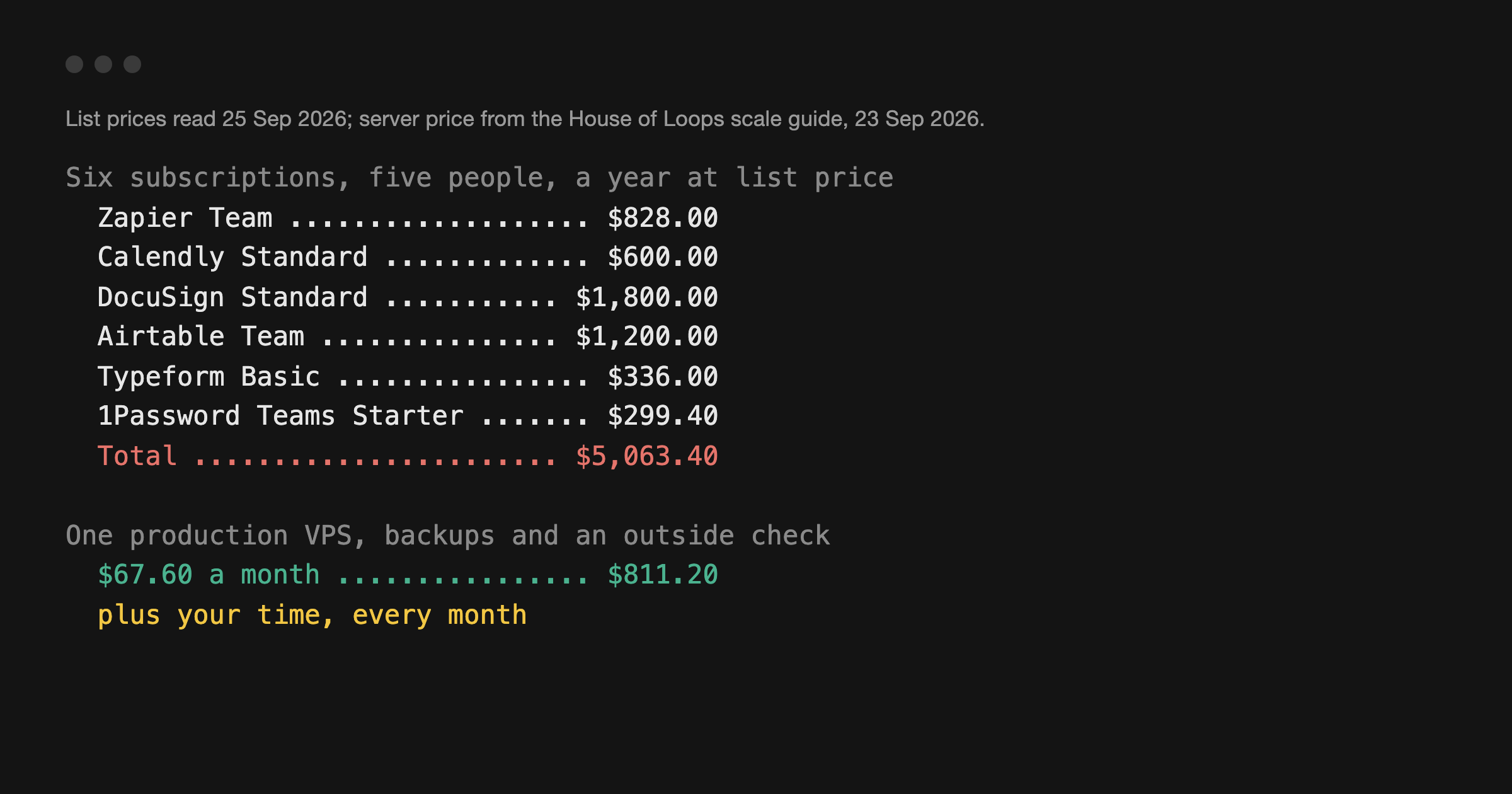
These six are common in small teams, and each has a self-hosted alternative with a House of Loops course behind it. The yearly figure is five people at the list price shown.
| Subscription (plan) | List price, 25 Sep 2026 | A year for five |
|---|---|---|
| Zapier (Team) | From $69 a month | $828.00 |
| Calendly (Standard) | $10 a seat a month | $600.00 |
| DocuSign eSignature (Standard) | $30 a user a month, annual commitment billed monthly | $1,800.00 |
| Airtable (Team) | $20 a seat a month, billed annually | $1,200.00 |
| Typeform (Basic) | $28 a month, billed yearly, one user | $336.00 |
| 1Password (Teams Starter Pack) | $24.95 a month, billed annually, 10 people included | $299.40 |
| Total | $5,063.40 |
Sources: zapier.com/pricing, calendly.com/pricing, docusign.com eSignature plans, airtable.com/pricing, typeform.com/pricing and 1password.com/pricing/business, read 25 September 2026. Zapier is its Team plan, the one for more than one user, at its starting price. DocuSign is the price its page showed by default. Typeform Basic covers one user, so it is counted once.
And the self-hosted app each course teaches in its place. Licences vary. Documenso and Vaultwarden are AGPL-3.0 open source. n8n is fair-code, with limits on commercial use, explained in Is n8n free?. Read each licence before you build a business on one.
| Instead of | Self-hosted | Course |
|---|---|---|
| Zapier | n8n | n8n Self-Hosting |
| Calendly | Cal.com | Cal.com and Documenso |
| DocuSign | Documenso | Cal.com and Documenso |
| Airtable | NocoDB or Baserow | Postgres, Supabase and NocoDB; Directus and Baserow |
| Typeform | Typebot | Typebot and Chatwoot |
| 1Password | Vaultwarden | Vaultwarden and Nextcloud |
You would not buy all six. The point is the order of magnitude: a few thousand dollars a year for a small team, most of it per seat, so it grows with every hire.
Analytics is the same story at a smaller scale. The Umami vs Plausible post measured both self-hosted, and lists their hosted prices.
What should you keep paying for?
Some subscriptions earn their price. Keep these.
- Payments. You cannot self-host a card network. Stripe or another processor stays.
- Email delivery. Even a self-hosted newsletter tool like Listmonk sends through an SMTP provider such as Resend, Postmark or Amazon SES, for their IP reputation. The House of Loops Listmonk course does exactly that.
- The integration that exists nowhere else. If an app only ever built a Zapier integration and you run it a few hundred times a month, Zapier is cheaper than your time writing an API client. That is the rule in lesson 2 of Choosing Your Stack.
- Anything you will not maintain. From lesson 5 of the same course: if patching, certificates and upgrades cost more hours a month than a managed alternative costs in money, move.
- The hosted version of an open-source tool. Many projects sell hosting of their own software. Plausible and Umami both do, and it funds their open-source work. You keep the option to move to self-hosting later, and someone else carries the pager now.
What does self-hosting really cost?
Three costs, and only the first shows up on an invoice.
Money: the server
The House of Loops scale guide prices real setups for a production n8n stack, with every line sourced (checked 23 September 2026):
| Setup | Cost | What you get |
|---|---|---|
| Homelab, a Beelink EQ14 mini PC | $385.00 once, then about $0.80 a month of power | Learning and your own automations. No SLA |
| One VPS on DigitalOcean, 8 GiB, with backups, a small second host for outside checks and off-site storage | $67.60 a month | Standard: tested restore, an outside check that pages a person |
| One VPS at Hetzner EU, when its plans can be ordered | €19.88 ($23.68) a month | The cheaper variant. Plans showed "not available" on 23 September 2026 |
Against $5,063 of subscriptions, even the $67.60 server is about $811 a year. The money case is easy. It is the other two costs that decide it.
Time: the upkeep
Every self-hosted app needs the same routine. The House of Loops production stack writes it down for n8n:
./backup-now.sh
# edit .env: N8N_VERSION=<new version>  (n8n and runners move together)
docker compose pull
docker compose up -d --wait
./smoke-test.sh
That is the upgrade, "at least monthly", after reading the release notes. The backup stack adds a restore test "after every change to the stack, and at least monthly". For one n8n install, Choosing Your Stack budgets "about an hour a month". Six apps multiply that routine. Putting them on one box, with one backup job and one upgrade day, keeps it manageable. It never makes it zero.
Risk: nobody tells you when it breaks
This is the cost people skip. On 20 September 2026, two of the nine services on my own homelab box were down after upgrades, and nothing told me. The tunnel, the DNS and the host were fine. The two apps had failed to start after their upgrades. A SaaS vendor has a team watching its status page. On your own box, that is a monitor you have to set up, or a customer who tells you.
So budget for a monitor from day one, and for testing a restore before you need one. Both are cheap. Neither happens by default.
Where do AI agents fit in?
They are why this is a 2026 question. An agent that reads your support inbox, drafts a reply and updates a record needs somewhere to run and data it may read. If the data lives in six vendors' databases, the agent works through six vendors' APIs, limits and prices.
Own the stack and the agent can run next to the data. This week's posts cover the pieces: a local model with Ollama, a small agent loop with a check and a stop rule, and the runbook you want when it breaks.
How do you start without betting the business?
Start with a sandbox you can throw away. The House of Loops starter compose file, free as lesson 8 of Docker and Self-Hosting Essentials, runs Dockge, Ollama and n8n on your own machine, every port on 127.0.0.1. In a lab run on 25 September 2026 (Docker Engine 29.8.0 on an Apple M1 Ultra, images already downloaded), docker compose up -d had all three healthy about 30 seconds later, and the default 1.3 GB llama3.2:1b model pulled in 17 seconds.
From the unzipped starter folder, copy the example settings, set TZ and DOCKGE_STACKS_DIR in .env, create the stacks folder, and start it:
cp .env.example .env
mkdir -p "$HOME/stacks"
docker compose up -d
docker compose logs -f ollama-pull
The pull ends with success. Then open n8n at http://127.0.0.1:5678 and Dockge at http://127.0.0.1:5001, and create Dockge's admin login straight away: until you do, anything that can reach port 5001 can create it, and Dockge controls Docker.
Then pick one subscription from the table, the one whose renewal is soonest, and run its replacement side by side for a month. Keep the one you would rather maintain.
Frequently asked questions
Is SaaS dead?
No. Renting software is still right for payments, email delivery and anything you will not operate. What changed is the pressure on per-seat pricing, and the maturity of alternatives a small team can run on one server.
What is the SaaSpocalypse?
The name given to the sharp fall in software shares in early February 2026, on fears about what AI would do to per-seat software. It describes a market move, not the end of software you rent.
What is self-hosting?
Running an application on a server you control instead of renting it. You get your data and no per-seat bill, and you take on backups, upgrades and monitoring.
How much can a small team save by self-hosting?
Six common subscriptions for five people came to $5,063 a year at list prices on 25 September 2026. The scale guide's production server was $67.60 a month, about $811 a year, before your time.
What should you not self-host?
Payments, email delivery, integrations that exist nowhere else at low volume, and anything whose upkeep costs more than the subscription.
Sources
- Vendor pricing pages listed under the table, read 25 September 2026.
- House of Loops scale guide (premium kit,
scale-guide/README.md), prices checked 23 September 2026. - House of Loops production stack READMEs (
stacks/production,stacks/03-backups): upgrade and restore routine. - House of Loops courses: Choosing Your Stack (lessons 2 and 5), Listmonk newsletters (lesson 0), and the courses named in the table.
- Free starter lab run, 25 September 2026, Docker 29.8.0 on an Apple M1 Ultra.
- Bloomberg, "What's Behind the 'SaaSpocalypse' Plunge in Software Stocks", 4 February 2026. CNBC, "AI fears pummel software stocks: Is it 'illogical' panic or a SaaS apocalypse?", 6 February 2026. Headlines only; both pages refused automated reads on 25 September 2026.
- Search data: DataForSEO data in House of Loops keyword research, September 2026, US, monthly.
The starter compose file is free in the House of Loops classroom, as lesson 8 of Docker and Self-Hosting Essentials. Choosing Your Stack is a Premium course: plain decision rules for automation, apps, data, hosting and AI, and a five-question scorecard you can run on any tool. See both on the syllabus, then join House of Loops free on Skool to get the starter file.
Shannon Atkinson
House of Loops is a free community for people who would rather own their automation stack than rent it: n8n, Claude Code, AI agents, local models and the self-hosting underneath them, across 44 courses in the classroom.
Join Our Community